Buy beauty-lounge.eu ?
We are moving the project
beauty-lounge.eu .
Are you interested in purchasing the domain
beauty-lounge.eu ?
domain@kv-gmbh.de · 0541-91531010
Buy beauty-lounge.eu ?
What did Poggio steal?
Poggio Bracciolini, an Italian scholar and scribe, is known for stealing a manuscript containing the only surviving copy of Lucretius' "De rerum natura" (On the Nature of Things) from a German monastery in the 15th century. This act of theft was significant because it led to the rediscovery and subsequent dissemination of this important work of ancient Roman poetry and philosophy, which had been lost for centuries. Poggio's theft played a crucial role in preserving and transmitting the ideas of Lucretius to future generations. **
What is the name of this mobile phone song Ai di di di di di di dai? I think it's a Russian song.
The song you are referring to is "Ai, Ai, Ai" by the Russian artist Polina Gagarina. It is a popular Russian pop song that gained international recognition. The catchy melody and upbeat rhythm have made it a favorite for mobile phone ringtones and music downloads. If you enjoy this song, you may also like other hits by Polina Gagarina. **

Similar search terms for Il-Vigneto-di-Poggio
Top-Angebote
Products related to Il-Vigneto-di-Poggio:
-
Brunello di Montalcino Poggio di Sotto 2020Poggio di Sotto è uno dei grandi nomi del Brunello di Montalcino. È storia e tradizione, classicità e stile inconfondibile. Si tratta di una delle vesti più eleganti del Sangiovese, vitigno autoctono toscano che si è fatto conoscere in tutto il mondo per il suo carattere affascinante e nobile. Nasce presso la zona di Castelnuovo dell’Abate, in provincia di Siena, da vigneti collocati ad un’altitudine che va dai 200 ai 450 metri sul livello del mare. Nel Brunello di Poggio di Sotto c’è tutta l’eloquente espressività del Sangiovese locale e c’è anche molta naturalezza, sottolineata anche dalla scelta dei metodi produttivi che seguono fedelmente la tradizione. Il Brunello di Montalcino di Poggio di Sotto è la purezza più chiara e limpida del Sangiovese. Le uve vengono selezionate con estrema e rigorosa cura e trasportate in cantina, dove avviene la vinificazione che si svolge all’interno di tini di legno. La fase di macerazione con le bucce è molto lunga, come da tradizione, e le fermentazioni prendono avvio spontaneamente. L’affinamento ha una durata di circa 48 mesi in grandi botti di rovere ed è seguito da un ulteriore periodo di maturazione in bottiglia di almeno 8 mesi. Il Poggio di Sotto Brunello si presenta con un bellissimo colore rosso rubino luminoso. Il suo profumo è complesso e affascinante, articolato in sentori di frutta scura matura e in confettura, tabacco, terra e tracce vegetali, tutto perfettamente inserito in una trama speziata. Al gusto mostra un tannino evidente ma ben gestito ed integrato ad una struttura carnosa ed avvolgente. Il profilo fresco e sapido scandisce l’eleganza e la longevità di questo signore che porta con sé uno scrigno prezioso, colmo di storie da raccontare.195,00 £*Shipping: 48,00 £Secure redirect to the provider
-
Rosso di Montalcino Poggio di Sotto 2023This Red wine from Montalcino is the result of the great bond between terroir, grape variety, and company savoir-faire. The Poggio di Sotto winery presents itself as a productive reality deeply rooted in Montalcino, which for almost thirty years has been creating outstanding red wines, banning the use of chemicals and relying on the right mix of ancestral methods and modern technologies. A red deep and compact, where the elegance of the aromas on the nose is enhanced by great harmony, which is also found in the tasting. This Rosso di Montalcino is made from pure grapes of a variety that, in Tuscany, finds noteworthy organoleptic expressions, Sangiovese. The vines of this variety are cultivated with the spurred cordon in vineyards located at an altitude between 200 and 450 meters above sea level, characterized by a subsoil rich in skeleton. The grapes, once harvested by the Poggio di Sotto team, ferment spontaneously in wooden tanks, macerating for a long time with air pump-overs without filtration.Then follows the important aging phase, during which the wine rests for 24 months in Slavonian oak barrels, and then, after bottling, for another 6 months directly in glass. The Red wine from Montalcino signed Poggio di Sotto manifests in the glass with a very bright and attractive color, reminiscent of ruby. The nose is dominated by fruity aromas, enriched by woody and spicy sensations, which also hint at subtle nuances of aromatic herbs. On the palate, it is full-bodied, soft and delicate, with a sip characterized by a fruity taste from which a pleasant savory vein emerges. A bottle where drinking becomes almost an automatic gesture, confirming the Poggio di Sotto winery as one of the reference realities of the entire territory.66,00 £*Shipping: 48,00 £Secure redirect to the provider
-
Il Guardiano Poggio Mandorlo 2021Poggio Mandorlo presents ‘Il Guardiano’, a Supertuscan made exclusively in steel, in order to preserve the freshness and all the varietal components of the grapes at the base of the blend: Sangiovese and Merlot. We are in Toscana, at the foot of Monte Amiata, in the heart of Alta Maremma. Here, Poggio Mandorlo cultivates 12 hectares of vineyards planted with Sangiovese, Merlot, and Cabernet Franc, varieties that benefit from volcanic soils and a mild, breezy climate. The first vintage produced of this label was 2009. ‘Il Guardiano’ Poggio Mandorlo comes from a blend of Sangiovese (85%) and Merlot (15%), planted between 2001 and 2002 on soils made up of sandstone marls and limestone, at about 400 meters above sea level. Following manual harvesting and careful selection, the grapes are transferred to the winery for alcoholic fermentation in steel tanks at controlled temperature, with 16-18 days of contact between the must and the skins. The subsequent maturation period always takes place in steel for 18 months, followed by 4-6 months of refinement in bottle before its market release. To the eye, Poggio Mandorlo ‘Il Guardiano’ presents itself with a dark ruby red color. Intense and complex are the fruity and floral perceptions, accompanied by aromas of underbrush and aromatic herbs, while the tasting is soft and balanced, supported by lively freshness and moderate tannic structure. Fragrant returns of great taste-olfactory correspondence. A bottle capable of highlighting the most refreshing and pure character of this blend, to be paired with various preparations based on local meats, such as lamb stew or pappardelle with hare ragù.14,00 £*Shipping: 48,00 £Secure redirect to the provider
-
Adami Prosecco di Valdobbiadene Dry 'Vigneto Giardino - Rive di Colbertaldo'Prosecco di Valdobbiadene "Rive di Colbertaldo" is a silky sparkling wine made using the Martinotti or Charmat method. It represents one of the flagship labels of the Val d’Oca winery in Valdobbiadene. It is, in fact, a selection of grapes coming exclusively from the Rive di Colbertaldo cru, a particularly suited parcel in the hilly area of Valdobbiadene. The Extra-Dry dosage makes the sip soft and enveloping, particularly pleasant and perfect to enjoy at aperitif time. The Prosecco "Rive di Colbertaldo" originates in the splendid territory of Valdobbiadene, in the classic and historical area of Prosecco Superiore. The cool climate, influenced by the nearby Prealps, the beautiful sunny exposures, and the suitable soils contribute to producing high-quality grapes. The Glera vines of the Rive di Colbertaldo cru are located in the territory of the municipality of Vidor and are cultivated on a steep slope. After the gentle pressing of the grapes, the must is fermented in steel, and the base wines always rest in steel for a few months. The second fermentation takes place in autoclave according to the Martinotti or Charmat sparkling method, which preserves the floral and fruity aromas of the Glera. "Rive di Colbertaldo" is an elegant and refined Prosecco, a perfect expression of the great tradition of the territory and the best characteristics of the Glera grape. In the glass, it presents itself with a pale straw yellow color with greenish reflections. The perlage is fine, with delicate and light foam. On the nose, it expresses floral scents, citrus notes, aromas of white fruit, pear, and apple. The sip is lively and intense, with juicy and enveloping fruit that leads the drink towards a savory finish and balanced freshness.18,00 £*Shipping: 48,00 £Secure redirect to the provider


-
When do you use il faut and il ne faut pas?
"Il faut" is used to express what is necessary or required, while "il ne faut pas" is used to express what is not allowed or should be avoided. For example, you would use "il faut" to say "il faut étudier pour réussir" (it is necessary to study to succeed), and "il ne faut pas" to say "il ne faut pas fumer dans ce lieu" (smoking is not allowed in this place). These expressions are used to give advice, make recommendations, or set rules. **
-
What is the difference between il faut que and il faut?
"Il faut" is used to express a general necessity or obligation, while "il faut que" is used to introduce a specific action or event that is necessary or required. For example, "il faut manger" means "it is necessary to eat" in a general sense, while "il faut que tu manges" means "you need to eat" in a specific sense. "Il faut" is used to make a general statement about what is necessary, while "il faut que" is used to specify what needs to be done. **
-
Why is it souhaite-t-il and not souhaite-s-il?
In French, the pronoun "il" (he) is combined with the verb "souhaiter" (to wish) to form the phrase "souhaite-t-il" because of the rule of verb inversion in interrogative sentences. When forming a question in French, the subject pronoun and the verb are inverted, so "souhaite-t-il" follows this rule. The "t" is added to create a liaison between the verb and the pronoun, making the pronunciation smoother. **
-
What does 'Rucke di guck, Rucke di guck, Blut ist im Schuh' mean?
"Rucke di guck, Rucke di guck, Blut ist im Schuh" is a German nursery rhyme that translates to "Rock-a-bye baby, blood is in the shoe" in English. The rhyme is a traditional lullaby that tells the story of a baby being rocked to sleep while blood is found in their shoe, which is a metaphor for the baby being cared for and protected. The rhyme is meant to soothe and comfort children as they drift off to sleep. **


What comes after il faudrait in French?
In French, "il faudrait" is followed by the infinitive form of a verb. This construction is used to express a suggestion or a polite request. For example, "il faudrait partir tôt" means "it would be necessary to leave early." **
How does "il faut" work in French?
"Il faut" is a common expression in French that is used to convey the idea of necessity or obligation. It is followed by an infinitive verb and is used to express what needs to be done or what is necessary in a given situation. For example, "Il faut manger" means "It is necessary to eat." This expression is used to give advice, make suggestions, or express general truths. **
Top-Angebote
Products related to Il-Vigneto-di-Poggio:
-
Il Vigneto di Poggio' Poggio Mandorlo 2023“The Vineyard of Poggio” by Poggio Mandorlo is a proud expression of the rich wine landscape of Maremma. It tells the story of four friends: Roberto, Felice, Giuseppe, and Fabio, who for about twenty years have decided to experiment with the potential of a territory. Supported by the oenologist Roberto Cipresso first and then Filippo Paoletti, noted figures from the Montalcino area, they have managed to navigate the virtues of the Seggiano soils to obtain unique and never banal labels. Located at the crossroads between Val Norcia and the first hills of the Grosseto Maremma, at the foot of the Amiata volcano, the winery decides to cultivate not only Sangiovese but also rare and unique clones of Merlot and Cabernet Franc, which they import directly from Saint-Émilion in the Bordeaux region. The latest offspring of Poggio Mandorlo is precisely “the Vineyard of Poggio”, capable of expressing the versatility of the sandstone and limestone marls on which the Merlot, of which this interesting label is entirely composed, takes root. The vines were planted in 2001 and the harvest is carried out exclusively with manual selection. Fermentation takes place in stainless steel tanks at controlled temperature, during which delicate pump-overs are performed. The maceration period varies from 8 to 12 days and is meticulously monitored through chemical and sensory analysis. The 12 months of aging also take place in steel, giving us a bottle that perfectly expresses the great varietal rigor even through an international grape variety. Poggio Mandorlo with its “Vigneto di Poggio” of pure Merlot envelops us with its shining ruby veil to gift us with scents of wilted rose and wild fruit, pleasant notes of plum, underbrush, cherry, and a finish of black pepper and cinnamon. On the palate, it presents warm aromas for a full body in which the fragrance of red fruit is found, with a pleasant fresh shoulder softened by a good sapidity, the tannin is tasty and almost caressing. Poggio Mandorlo expresses all its commitment to the passion for the land and the love for good wine, reflecting in the personality of this pleasing label.12,00 £*Shipping: 48,00 £Secure redirect to the provider
-
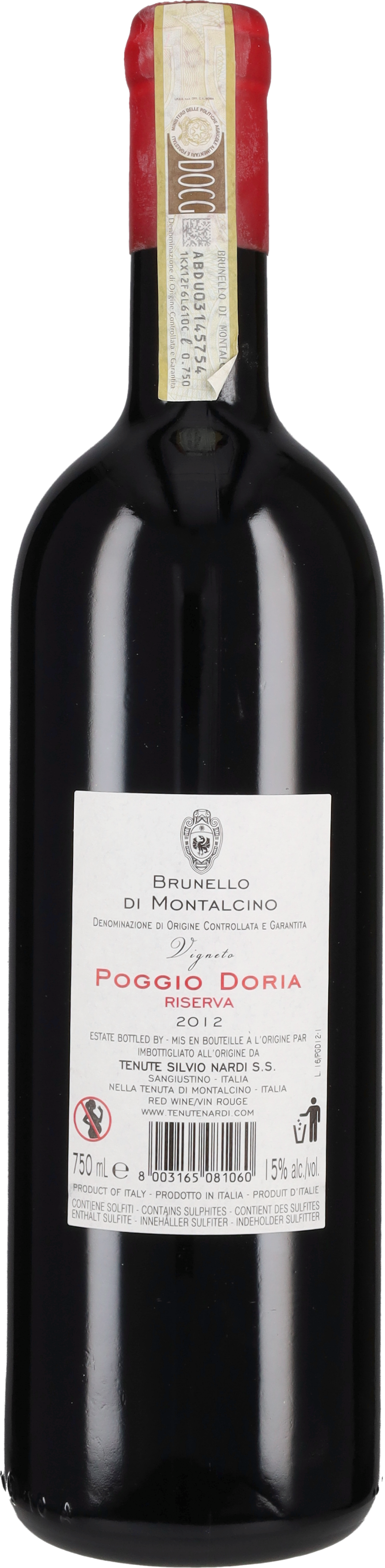
Brunello di Montalcino 'Vigneto Poggio Doria' Tenute Silvio Nardi 2012The Brunello di Montalcino Tenute Silvio Nardi ‘Vigneto Poggio Doria’ is a prestigious label capable of reflecting the elegance of Montalcino wines. The grapes destined for the Brunello ‘Vigneto Poggio Doria’ come from the Oria parcel, located on the north-western slope of Montalcino and part of the Tenuta di Casale del Bosco, the first purchased by the Nardi family. This estate dates back to the 17th century, although even in much earlier times the Etruscans practiced viticulture in the area. The ‘Vigneto Poggio Doria’ Tenute Silvio Nardi Brunello di Montalcino is a 100% Sangiovese from vines grown at an altitude of about 260 meters above sea level, on soils rich in limestone, sands, and clays, also characterized by an abundance of skeleton. After the manual harvest of the bunches, usually carried out during the second week of October, the grapes are crushed in stainless steel tanks, where alcoholic fermentation takes place at controlled temperature with 26 days of contact between the must and the skins. Once the fermentation process is completed,fermentative, the liquid is transferred into French oak tonneau from Allier, of first and second passage, for the initial aging phase of 18 months. This is followed by 12 months of maturation in large Slavonian oak barrels before bottling and further refinement in glass for as long as 36 months, aimed at bringing to market a Brunello that is already harmonious and enjoyable. The Brunello di Montalcino ‘Vigneto Poggio Doria’ by Tenute Silvio Nardi is ruby red in color with a garnet rim. The nose opens with notes of wild berries and violet, followed by mineral hints of graphite and spicy notes of nutmeg, clove, and vanilla. On the palate, it is rich, full, and harmonious, broad and enveloping, with velvety tannins that lead to a persistent and well-balanced finish.105,00 £*Shipping: 48,00 £Secure redirect to the provider
-
Brunello di Montalcino Poggio di Sotto 2020Poggio di Sotto è uno dei grandi nomi del Brunello di Montalcino. È storia e tradizione, classicità e stile inconfondibile. Si tratta di una delle vesti più eleganti del Sangiovese, vitigno autoctono toscano che si è fatto conoscere in tutto il mondo per il suo carattere affascinante e nobile. Nasce presso la zona di Castelnuovo dell’Abate, in provincia di Siena, da vigneti collocati ad un’altitudine che va dai 200 ai 450 metri sul livello del mare. Nel Brunello di Poggio di Sotto c’è tutta l’eloquente espressività del Sangiovese locale e c’è anche molta naturalezza, sottolineata anche dalla scelta dei metodi produttivi che seguono fedelmente la tradizione. Il Brunello di Montalcino di Poggio di Sotto è la purezza più chiara e limpida del Sangiovese. Le uve vengono selezionate con estrema e rigorosa cura e trasportate in cantina, dove avviene la vinificazione che si svolge all’interno di tini di legno. La fase di macerazione con le bucce è molto lunga, come da tradizione, e le fermentazioni prendono avvio spontaneamente. L’affinamento ha una durata di circa 48 mesi in grandi botti di rovere ed è seguito da un ulteriore periodo di maturazione in bottiglia di almeno 8 mesi. Il Poggio di Sotto Brunello si presenta con un bellissimo colore rosso rubino luminoso. Il suo profumo è complesso e affascinante, articolato in sentori di frutta scura matura e in confettura, tabacco, terra e tracce vegetali, tutto perfettamente inserito in una trama speziata. Al gusto mostra un tannino evidente ma ben gestito ed integrato ad una struttura carnosa ed avvolgente. Il profilo fresco e sapido scandisce l’eleganza e la longevità di questo signore che porta con sé uno scrigno prezioso, colmo di storie da raccontare.195,00 £*Shipping: 48,00 £Secure redirect to the provider
-
Rosso di Montalcino Poggio di Sotto 2023This Red wine from Montalcino is the result of the great bond between terroir, grape variety, and company savoir-faire. The Poggio di Sotto winery presents itself as a productive reality deeply rooted in Montalcino, which for almost thirty years has been creating outstanding red wines, banning the use of chemicals and relying on the right mix of ancestral methods and modern technologies. A red deep and compact, where the elegance of the aromas on the nose is enhanced by great harmony, which is also found in the tasting. This Rosso di Montalcino is made from pure grapes of a variety that, in Tuscany, finds noteworthy organoleptic expressions, Sangiovese. The vines of this variety are cultivated with the spurred cordon in vineyards located at an altitude between 200 and 450 meters above sea level, characterized by a subsoil rich in skeleton. The grapes, once harvested by the Poggio di Sotto team, ferment spontaneously in wooden tanks, macerating for a long time with air pump-overs without filtration.Then follows the important aging phase, during which the wine rests for 24 months in Slavonian oak barrels, and then, after bottling, for another 6 months directly in glass. The Red wine from Montalcino signed Poggio di Sotto manifests in the glass with a very bright and attractive color, reminiscent of ruby. The nose is dominated by fruity aromas, enriched by woody and spicy sensations, which also hint at subtle nuances of aromatic herbs. On the palate, it is full-bodied, soft and delicate, with a sip characterized by a fruity taste from which a pleasant savory vein emerges. A bottle where drinking becomes almost an automatic gesture, confirming the Poggio di Sotto winery as one of the reference realities of the entire territory.66,00 £*Shipping: 48,00 £Secure redirect to the provider
-
What did Poggio steal?
Poggio Bracciolini, an Italian scholar and scribe, is known for stealing a manuscript containing the only surviving copy of Lucretius' "De rerum natura" (On the Nature of Things) from a German monastery in the 15th century. This act of theft was significant because it led to the rediscovery and subsequent dissemination of this important work of ancient Roman poetry and philosophy, which had been lost for centuries. Poggio's theft played a crucial role in preserving and transmitting the ideas of Lucretius to future generations. **
-
What is the name of this mobile phone song Ai di di di di di di dai? I think it's a Russian song.
The song you are referring to is "Ai, Ai, Ai" by the Russian artist Polina Gagarina. It is a popular Russian pop song that gained international recognition. The catchy melody and upbeat rhythm have made it a favorite for mobile phone ringtones and music downloads. If you enjoy this song, you may also like other hits by Polina Gagarina. **
-
When do you use il faut and il ne faut pas?
"Il faut" is used to express what is necessary or required, while "il ne faut pas" is used to express what is not allowed or should be avoided. For example, you would use "il faut" to say "il faut étudier pour réussir" (it is necessary to study to succeed), and "il ne faut pas" to say "il ne faut pas fumer dans ce lieu" (smoking is not allowed in this place). These expressions are used to give advice, make recommendations, or set rules. **
-
What is the difference between il faut que and il faut?
"Il faut" is used to express a general necessity or obligation, while "il faut que" is used to introduce a specific action or event that is necessary or required. For example, "il faut manger" means "it is necessary to eat" in a general sense, while "il faut que tu manges" means "you need to eat" in a specific sense. "Il faut" is used to make a general statement about what is necessary, while "il faut que" is used to specify what needs to be done. **
Similar search terms for Il-Vigneto-di-Poggio
-
Il Guardiano Poggio Mandorlo 2021Poggio Mandorlo presents ‘Il Guardiano’, a Supertuscan made exclusively in steel, in order to preserve the freshness and all the varietal components of the grapes at the base of the blend: Sangiovese and Merlot. We are in Toscana, at the foot of Monte Amiata, in the heart of Alta Maremma. Here, Poggio Mandorlo cultivates 12 hectares of vineyards planted with Sangiovese, Merlot, and Cabernet Franc, varieties that benefit from volcanic soils and a mild, breezy climate. The first vintage produced of this label was 2009. ‘Il Guardiano’ Poggio Mandorlo comes from a blend of Sangiovese (85%) and Merlot (15%), planted between 2001 and 2002 on soils made up of sandstone marls and limestone, at about 400 meters above sea level. Following manual harvesting and careful selection, the grapes are transferred to the winery for alcoholic fermentation in steel tanks at controlled temperature, with 16-18 days of contact between the must and the skins. The subsequent maturation period always takes place in steel for 18 months, followed by 4-6 months of refinement in bottle before its market release. To the eye, Poggio Mandorlo ‘Il Guardiano’ presents itself with a dark ruby red color. Intense and complex are the fruity and floral perceptions, accompanied by aromas of underbrush and aromatic herbs, while the tasting is soft and balanced, supported by lively freshness and moderate tannic structure. Fragrant returns of great taste-olfactory correspondence. A bottle capable of highlighting the most refreshing and pure character of this blend, to be paired with various preparations based on local meats, such as lamb stew or pappardelle with hare ragù.14,00 £*Shipping: 48,00 £Secure redirect to the provider
-
Adami Prosecco di Valdobbiadene Dry 'Vigneto Giardino - Rive di Colbertaldo'Prosecco di Valdobbiadene "Rive di Colbertaldo" is a silky sparkling wine made using the Martinotti or Charmat method. It represents one of the flagship labels of the Val d’Oca winery in Valdobbiadene. It is, in fact, a selection of grapes coming exclusively from the Rive di Colbertaldo cru, a particularly suited parcel in the hilly area of Valdobbiadene. The Extra-Dry dosage makes the sip soft and enveloping, particularly pleasant and perfect to enjoy at aperitif time. The Prosecco "Rive di Colbertaldo" originates in the splendid territory of Valdobbiadene, in the classic and historical area of Prosecco Superiore. The cool climate, influenced by the nearby Prealps, the beautiful sunny exposures, and the suitable soils contribute to producing high-quality grapes. The Glera vines of the Rive di Colbertaldo cru are located in the territory of the municipality of Vidor and are cultivated on a steep slope. After the gentle pressing of the grapes, the must is fermented in steel, and the base wines always rest in steel for a few months. The second fermentation takes place in autoclave according to the Martinotti or Charmat sparkling method, which preserves the floral and fruity aromas of the Glera. "Rive di Colbertaldo" is an elegant and refined Prosecco, a perfect expression of the great tradition of the territory and the best characteristics of the Glera grape. In the glass, it presents itself with a pale straw yellow color with greenish reflections. The perlage is fine, with delicate and light foam. On the nose, it expresses floral scents, citrus notes, aromas of white fruit, pear, and apple. The sip is lively and intense, with juicy and enveloping fruit that leads the drink towards a savory finish and balanced freshness.18,00 £*Shipping: 48,00 £Secure redirect to the provider
-
Poggio Bestiale Fattoria di Magliano 2020The red wine Poggio Bestiale Fattoria di Magliano is born from a Bordeaux blend where the different grape varieties used, thanks to the perfect balance between altitude, soil, and microclimate, find the ideal conditions for perfect growth, creating a bottle with a harmonious character and excellent longevity. A typical expression of that Maremma Toscana so dear to Agostino Lenci, the owner of the winery who in 1996 fell in love with that still wild strip of land between the Tyrrhenian Sea and the Argentario, deciding to start his winemaking adventure there. A challenging but rewarding journey, which gives birth to products of personality and character, just like Poggio Bestiale. The red produced by Fattoria di Magliano is a blend based on four international red grape varieties: Merlot, Cabernet Sauvignon, Cabernet Franc, and Petit Verdot, cultivated at about 250 meters above sea level on soils rich in skeletal remains. The grapes, which are grown according to organic principles, after harvesting, ferment in steel containers for about 20-25 days, then age for 14-18 months in new Allier oak barrels before being bottled. Poggio Bestiale is a red wine produced by Fattoria di Magliano, characterized by a deep and intense ruby color. The nose is penetrating and characterful, with an aromatic profile where cherry notes give way to enveloping spicy and balsamic aromas. On the palate, it is full-bodied, rich and smooth, with a sip marked by a good acidic vein and finely crafted tannins. A label with a strongly international character, to be enjoyed immediately or kept in the cellar for a few more years to taste it in a more evolved version: in either case, it will not disappoint you.21,00 £*Shipping: 48,00 £Secure redirect to the provider
-
Adami Prosecco di Valdobbiadene Superiore Dry 'Vigneto Giardino - Rive di ColProsecco di Valdobbiadene “Rive di Colbertaldo” Magnum is a refined sparkling wine made using the Martinotti or Charmat method. It represents one of the flagship labels of the Val d’Oca winery in Valdobbiadene. It is, in fact, a selection of grapes coming only from the Rive di Colbertaldo cru, a particularly suited parcel of the hilly area of Valdobbiadene. The Extra-Dry dosage makes the sip soft and enveloping, particularly pleasant and perfect to enjoy at aperitif time. The Prosecco Superiore “Rive di Colbertaldo” is born in the splendid territory of Valdobbiadene, in the classic and historical area of Prosecco Superiore. The cool climate, influenced by the nearby Prealps, the beautiful sunny exposures, and the suited soils contribute to giving high-quality grapes. The Glera vines of the Rive di Colbertaldo cru are located in the territory of the municipality of Vidor and are cultivated on a steep slope. After the soft pressing of the grapes, the must is fermented in steel and the base wines always rest in steel for a few months. The second fermentation takes place in autoclave according to the Martinotti or Charmat sparkling method, which preserves the floral and fruity aromas of the Glera. “Rive di Colbertaldo” is an elegant and refined Prosecco in Magnum format, a perfect expression of the great tradition of the territory and the best characteristics of the Glera grape. In the glass, it presents a pale straw yellow color with greenish reflections. The perlage is fine, with delicate and light foam. On the nose, it expresses floral scents, citrus notes, aromas of white fruit, pear, and apple. The sip is lively and intense, with juicy and enveloping fruit that leads the drink towards a savory finish and balanced freshness.36,00 £*Shipping: 48,00 £Secure redirect to the provider
-
Why is it souhaite-t-il and not souhaite-s-il?
In French, the pronoun "il" (he) is combined with the verb "souhaiter" (to wish) to form the phrase "souhaite-t-il" because of the rule of verb inversion in interrogative sentences. When forming a question in French, the subject pronoun and the verb are inverted, so "souhaite-t-il" follows this rule. The "t" is added to create a liaison between the verb and the pronoun, making the pronunciation smoother. **
-
What does 'Rucke di guck, Rucke di guck, Blut ist im Schuh' mean?
"Rucke di guck, Rucke di guck, Blut ist im Schuh" is a German nursery rhyme that translates to "Rock-a-bye baby, blood is in the shoe" in English. The rhyme is a traditional lullaby that tells the story of a baby being rocked to sleep while blood is found in their shoe, which is a metaphor for the baby being cared for and protected. The rhyme is meant to soothe and comfort children as they drift off to sleep. **
-
What comes after il faudrait in French?
In French, "il faudrait" is followed by the infinitive form of a verb. This construction is used to express a suggestion or a polite request. For example, "il faudrait partir tôt" means "it would be necessary to leave early." **
-
How does "il faut" work in French?
"Il faut" is a common expression in French that is used to convey the idea of necessity or obligation. It is followed by an infinitive verb and is used to express what needs to be done or what is necessary in a given situation. For example, "Il faut manger" means "It is necessary to eat." This expression is used to give advice, make suggestions, or express general truths. **
* All prices are inclusive of VAT and, if applicable, plus shipping costs. The offer information is based on the details provided by the respective shop and is updated through automated processes. Real-time updates do not occur, so deviations can occur in individual cases. ** Note: Parts of this content were created by AI.